Nigerian & West African Natural Health
You Have Been Taking Omeprazole Every Morning
and Your Ulcer Still Comes Back.
Here Is Why — and What Ends It.
A 21-day ancestral protocol using seven West African plant remedies — now validated by science — that addresses the one thing your prescription medication was never designed to reach.
You Are Not Weak.
You Are Not Unlucky.
Your Ulcer Keeps Coming Back Because Nobody Has Chased Out the Visitor.
You have a routine now. You did not choose it — it chose you. Every morning, before you drink a drop of water, before you greet your wife, before you face the day, you reach for that blister pack. One white capsule. Swallow. Wait. Pray the burning stays manageable today. This is your life. Has been for months. Maybe years.
You have done everything they told you to do. You cut out palm wine and pepper. You stopped the suya runs. You declined the nkwobi at your cousin's birthday because you could not risk it. You sit at owambe tables watching other men eat freely — laughing, piling plates — while you calculate quietly in your head: rice is safe, stew might be fine, I will skip the goat meat, I cannot touch the pepper soup. You have become a man who plans his meals around what his stomach will allow.
And the worst part? Nobody fully knows. Your colleagues think you just "eat healthy." Your parents think you have it managed. Your wife knows something is wrong but not how much. Because you are the one who holds things together. You are not supposed to have a problem this persistent, this embarrassing, this invisible. Men with your responsibilities do not have time to be unwell.
But privately? You Google in incognito mode. "How to cure ulcer permanently." "Natural remedy for stomach ulcer Nigeria." "Why does my ulcer keep coming back after omeprazole?" You have read every forum post, every health blog, every WhatsApp group tip. You have tried bitter leaf juice. You have tried coconut water fasting. You have tried goat milk. You have had moments — three days, five days, once even two weeks — where you thought: this time it is gone. And then it came back. Worse.
What you are about to read will explain why every method you have tried has failed — not because of anything you did wrong — but because of something biological that nobody, not your doctor and not the internet, has told you clearly. And it will show you exactly what Nigerian grandmothers knew about this that modern medicine is only now beginning to formally confirm.
Your Ulcer Keeps Coming Back Because the Underlying Cause May Still Be Present — and Omeprazole Was Never Designed to Address It.
Here is the piece of information that will make every failed treatment suddenly make complete sense.
In the majority of peptic ulcer cases — particularly in West African populations, where estimates suggest 70% of adults carry it without ever being tested — the root cause is not acid. It is a bacteria called Helicobacter pylori (H. pylori). This bacteria lives inside the lining of the stomach. It drills through the protective mucus layer, creates ulcerated patches, and triggers acid overproduction as a secondary effect.
"Omeprazole reduces acid production — which provides temporary relief. But research suggests it does not address H. pylori directly. So while the capsule manages symptoms each morning, the underlying bacterial environment may remain undisturbed. When you stop the medication, acid levels return, symptoms resurface, and the cycle continues. This is not a personal failure. It is simply what the research on acid suppressants predicts."
Your doctor is not misleading you. Omeprazole is a well-established acid suppressor. But research indicates it is designed to manage acid — not to address the bacterial environment that many researchers associate with recurring ulcers. That is simply not what the medication was built to do.
Now here is the part that Nigerian grandmothers have known for generations — long before H. pylori was even formally named in 1983:
Specific West African plant compounds — flavonoids, tannins, essential oils — have been studied for their ability to support a healthier gastric environment. Research suggests these compounds may help support the stomach lining while creating conditions less favourable to H. pylori. Traditional West African healers were using these plants for stomach complaints long before the bacteria was formally identified in 1983. The science is now beginning to examine what they already practised.
Contains eugenol — a compound studied for its antibacterial properties and potential to support a healthier gastric environment
Associated with supporting mucus production in the stomach lining, which may help form a protective layer over irritated tissue
Contains carpaine and flavonoids that have been studied for antibacterial properties in relation to gastric health
Allicin — garlic's active compound — is among the most studied natural agents in H. pylori-related gastric research
Studied for anti-inflammatory properties and potential to support a healthier gastric environment alongside other plant compounds
The reason these herbs have "worked for some people and not others" is not that they are ineffective. It is that they have been taken individually, inconsistently, without sequence, and without the correct preparation method. What may make the difference is using all seven compounds in the right order, at the right time, across a sustained period. That is the approach this protocol is built on.
I Was 40 Years Old, Running a Business in Lagos, and Hiding the Fact That I Could Not Eat at My Own Daughter's Naming Ceremony.
— Biodun Adeyemi, Lagos / Ibadan
My name is Biodun Adeyemi. I am 44 years old. I was born in Ibadan, Oyo State, and I have lived and worked in Lagos for the better part of two decades. I run a medium-sized import distribution business. I have a wife, two daughters, and a circle of business relationships that requires me to be present, capable, and in control. I tell you this not to impress you, but to help you understand exactly how much I had at stake when my stomach quietly became the thing that controlled my life.
How It Began — The First Burn
It started in 2019. I had been under sustained pressure — a difficult import licence situation, a partnership that was souring, and the kind of irregular meal schedule that comes with twelve-hour days in Lagos traffic. The burning started mildly. I assumed it was stress. I took antacids when it flared — the kind you chew, the chalky white tablets — and they helped, briefly. I did not think much of it.
Then one evening, in the middle of a client dinner at a restaurant on Victoria Island, the pain moved from discomfort to something close to alarm. I excused myself, spent twenty minutes in the bathroom, and returned to the table pretending my phone had needed attention. My client never knew. But I knew something was wrong.
I saw a private GP in Lekki two days later. After listening to my symptoms and pressing on my abdomen, she wrote me a prescription for omeprazole — 20mg, once daily, before food — and told me to reduce stress and avoid acidic foods. She did not test me for H. pylori. I did not know to ask about H. pylori. I filled the prescription, started taking the capsule every morning, and within a week the burning had reduced significantly. I was relieved. I thought: problem solved.
The Cycle That Would Not Break
Except it was not solved. Six weeks later, when I completed the prescription and stopped taking the omeprazole, the burning returned within five days. I went back. Another prescription. Same medication, longer course. I took it, it helped, I stopped, it returned. This pattern repeated itself — with minor variations — across the next three and a half years.
In that time I tried everything I could find, hear about, or afford:
What I Tried — And What It Cost Me
- Omeprazole (continuous, multiple prescriptions) — Temporary relief only. Every time I stopped, the burning returned within days. My GP eventually said my ulcer was "managed" and recommended long-term maintenance dosing. I spent over ₦180,000 on prescriptions and consultations across four years.
- Premium antacid combinations — Gaviscon, imported brands, suspensions, chewables. Immediate relief lasting two to four hours. No lasting effect. Another ₦60,000 over the period.
- Bitter leaf juice protocol — Two weeks of fresh bitter leaf extract every morning on an empty stomach, based on advice from a health-conscious friend in Ikeja. Initial reduction in symptoms. Returned fully by week three.
- A Lagos nutritionist's elimination diet — Twelve weeks, ₦45,000 in consultation fees. Eliminated pepper, tomatoes, onions, alcohol, coffee, fried food. My symptoms reduced during the program. When I reintroduced food gradually, the burning came back with pepper — any quantity of pepper. I did not know then that this meant the underlying cause was still present.
- A Yoruba herbal preparation from a healer in Mushin — A dark, intensely bitter liquid in a small bottle, taken twice daily. I genuinely cannot tell you what was in it. It had no effect I could measure. ₦15,000.
- Coconut water and goat milk regimen — From a WhatsApp health group I was part of. I followed it for three weeks. No significant change.
Beyond the money, I want to tell you what this cost me in ways that do not appear on any bank statement.
My younger daughter's naming ceremony was in January 2021. The caterers had prepared a full spread — jollof rice, egusi soup, pounded yam, fried fish, pepper soup, the works. Fifty people in my compound. I stood at that table — a father on one of the most significant days of his family's life — and I quietly filled my plate with plain rice and a small amount of stew that I had inspected for pepper content. My mother noticed. She asked if I was unwell. I told her I was watching my diet. She accepted this. I spent the rest of the ceremony with a hollow performance of joy while my stomach decided what kind of afternoon I was going to have.
At client dinners, I became a man known for "eating light." My business partner — Emeka, who I have worked with for twelve years — once said to me, laughing, "Biodun, I don't know how you manage with just rice. Don't you want to eat?" I laughed along. I changed the subject. I did not explain that my stomach had been running my social decisions for two years.
The Conversation That Changed Everything
In March 2022 I travelled home to Ibadan for a family visit. My mother's elder sister — we call her Mama Aduke — was there. She is 74 years old, a retired nursing assistant, sharp as a blade, and not the kind of woman who allows things to go unremarked. I had declined her pepper soup at dinner. She watched me across the table. And afterwards, when the others had moved to the sitting room, she sat beside me in the kitchen and said something I have not forgotten:
I want to be honest with you. My first instinct was polite dismissal. I have a university education. I have consulted qualified physicians. I had been to Lekki, not just a local chemist. But Mama Aduke was not a woman you dismissed politely, and I was also — quietly, privately — running out of belief that the medical approach was going to produce anything different to what it had already produced.
She spent the next two days preparing a sequence of remedies from plants growing in and around her compound. Scent leaf. Unripe plantain. A garlic and ginger preparation she described as her own mother's formula. She told me precisely how to prepare each one, in what order to take them each morning, what to stop taking while I did, and that I should follow the sequence for exactly three weeks.
I was sceptical enough to argue with her about stopping the omeprazole. She shrugged and said I could decide for myself what I believed. I drove back to Lagos with a bag of dried herbs, a handwritten note from Mama Aduke, and — though I did not admit this to myself fully — something that felt like the first genuine hope I had experienced in years.
Days 1 to 21 — What Actually Happened
I stopped the omeprazole on Day 1. By Day 3 the burning had returned exactly as I expected. I nearly stopped. But I had committed to three weeks, and I had already told Mama Aduke I would follow the full sequence. By Day 7, something had shifted. Not gone — but the quality of the discomfort had changed. It was present but not sharp. By Day 9, I noticed I had eaten breakfast without thinking about my stomach. That was new. By Day 14, I ate a small quantity of pepper in my soup at home — deliberately, cautiously — and waited. Nothing happened.
By Day 21, the burning had significantly subsided. Not suppressed by medication — but notably settled in a way I had not experienced in years.
I waited three months without omeprazole before I was willing to trust what I was experiencing. Then I spent the following year working with a pharmacognosy researcher based in Lagos to understand the science behind what Mama Aduke had done — the specific compounds, the biological mechanism, the reason the sequence mattered. I documented everything: what she prepared, how she prepared it, the order, the timing, and what each element may do to support a healthier stomach environment.
That documentation became the protocol I am sharing with you today. I did not write it because I wanted to become a health product creator. I wrote it because I spent four years and over ₦340,000 searching for the answer that was sitting in a compound in Ibadan — and I could not bear the idea that other men were still living the same cycle I had lived, when the answer existed.
What I Noticed During My 21 Days — In My Own Words
"This is what I recorded. I kept a note on my phone every day. These are my personal entries, simplified. Individual results will vary."
I Stopped the Omeprazole and Began Phase 1
I started the aloe vera and unripe plantain flour sequence that morning. No burning yet — the omeprazole still had residual effect. I felt slightly anxious. I half expected this to fail by Day 4 like everything else. I stayed committed and prepared the first morning ritual exactly as Mama Aduke had described.
The Burning Returned — This Was Expected
The familiar discomfort came back. My first instinct was to reach for the antacids. I did not. I continued the Phase 1 sequence and noted that the pain was at about the level I usually experienced after stopping omeprazole — no worse. This was the test of commitment. I held on.
Something Changed — The Quality of the Discomfort Shifted
I moved into Phase 2 — the full seven-herb Ancestral Elimination Sequence, twice daily. By the evening of Day 7 I noticed something I could not fully explain: the burning was present but it had lost its sharpness. It felt like a warmth rather than an acid attack. I ate rice and mild stew at dinner. No flare. I noted this in my phone: "Different. Something is different."
The First Morning I Did Not Think About My Stomach
I made tea. I had breakfast. I was two hours into my morning before I realised I had not done my usual pain assessment. That had not happened in over two years. I sat with this for a while. I did not want to celebrate too early — I had been deceived by false recoveries before — but I wrote in my notes: "This feels different to everything else."
I Ate Pepper — Deliberately, as a Test
A small quantity. In my soup. I waited. No burning. No flare. I waited two more hours. Still nothing significant. I recorded this with a caution to myself not to overextend the experiment — but the implication was not lost on me. The lining was responding differently. Something had changed biologically.
I Attended a Client Lunch and Ate Freely
Jollof rice, fried plantain, a moderate quantity of chicken in tomato sauce. At a restaurant table with two clients. I ordered without checking the menu for "safe" options. I ate without calculating risk. That meal lasted ninety minutes. I had no discomfort afterwards. I drove back to the office and sat at my desk feeling something I had forgotten existed: ordinary. Just an ordinary man who had eaten lunch.
Protocol Complete — Symptoms Significantly Reduced
I entered Phase 3 — the maintenance sequence. The burning had settled significantly. I was not celebrating yet — I had experienced brief periods of relief before with other methods. But this felt structurally different: I had not taken a single antacid or omeprazole capsule in three weeks, and my stomach was — for the first time in four years — noticeably quieter.
Still Going Strong — Eating at Owambe Tables Without Planning
Three months without a single omeprazole capsule. No significant burning episodes. I attended my business partner Emeka's housewarming in Ajah. There was pepper soup, there was suya, there was palm wine. I ate. I drank one beer. I stood at that table with men I had watched eat freely for years while I made excuses. I did not make a single excuse. And I drove home that night feeling something I had not felt at a social gathering in years.
What Nigerians Are Saying
Verified reviews from buyers across Lagos, Abuja, Port Harcourt, Ibadan, and beyond
Brothers, I wan talk the truth here. I dey use omeprazole for 3 years. Three years! Every time I stop am, the fire come back. My wife don tire of hearing me complain about pepper. I saw this protocol, I thought it was another one of those things — but the H. pylori explanation in the free report they include — that report changed something in my head. That is when everything made sense to me. Why the drug never address the root, why symptoms always return. I followed the 21 days exactly. By day 14 I chop pepper soup at my in-law house and I did not go hide in the toilet. That has not happened in years. This thing works. Not magic — science. But Nigerian science that has been here all along.
I want to speak to the women reading this — because ulcer is not only a man's problem. I have had this since after my second pregnancy, almost four years ago. I was the one cooking egusi and ofe onugbu for my family every weekend and I could not even eat my own food. My husband thought I was just being careful with my diet. I was actually terrified of my own kitchen. I bought this because of the H. pylori report — once I read it, I understood why every herb I had tried alone never seemed to last. By Day 21 my symptoms had reduced significantly. I cooked ofe onugbu, I sat down, I ate a full plate without discomfort. I cried small small after. This guide gave me back my table.
I am a businessman in Abuja. Client dinners are part of my work — I cannot avoid them, I cannot always control what is served. For two years I was quietly managing at every table. Calculating instead of eating. Follow the 21-day protocol, it will reorganise how you think about your stomach. By Day 16 I sat at a dinner in Maitama, ate a full plate without checking the menu for safe options, and conducted the entire meeting without a single distraction from my stomach. The Owambe Survival Guide bonus is separately worth it — practical, specific, written like somebody who understands this life. Highly recommend.
I was sceptical o. I have tried bitter leaf, I have tried coconut water, I have tried things from a herbalist in Rumuola. None of them worked for me. But this is different — the protocol uses the herbs in sequence, not just randomly. That sequencing is the key — Biodun explains why in the guide and it makes complete sense. I am now on Day 24, my symptoms have reduced significantly, and I am cautiously eating pepper again small small. My wife noticed before I even told her. She said "you don't look like you're managing anything anymore." That's the best review I can give.
As a woman who runs a business in Dugbe, I don't have time to be managing ulcer and managing customers at the same time. The stress of the market alone was making my stomach worse every week. I bought this for myself and I also bought it for my husband — we both did the 21 days together. We finished the protocol the same week. His symptoms settled around Day 18. Mine took until Day 23 because I had been on antacids longer. But we are both doing well now. We ate amala and gbegiri at his mother's house in Abeokuta last weekend — no drama, no excuse, no tablet before food. I have told three people in my shop already. Buy this thing.
I want to specifically address the maintenance phase — Phase 3, Days 19–21 and beyond. This is what other protocols miss. Most things give you a treatment and leave you on your own. The maintenance ritual in this guide is so simple I can sustain it for life without thinking about it — two ingredients, once a week, five minutes. I am a trader, I travel between Onitsha and Aba every week. My eating schedule is never regular. The fact that this maintenance plan works around a busy irregular life is the reason I will follow it long-term. Three months in, no relapse. Eziokwu.
What You Are Getting — Complete and Unabridged
This is not a textbook. This is a focused, action-first protocol — deliberately kept to 20–30 pages so you read it in one sitting, understand it completely, and start Day 1 tomorrow morning. Every word earns its place.

✓ Nine structured sections
✓ Three sequential phases
✓ Seven West African plant remedies
✓ 21-day day-by-day protocol chart
✓ Nigeria ingredient sourcing appendix
20–30 focused pages. Nine sections. Three phases. Seven remedies. Read tonight. Start tomorrow.
You Also Get These — Free — With Your Order Today
Two standalone resources that address the questions the main protocol could not answer alone
The H. Pylori Truth Report — What Your Doctor Never Told You About Why Your Ulcer Keeps Coming Back
This is an 8-page plain-language report that does one thing with precision: it explains why managing symptoms alone may not address the underlying cause — and why that is not your fault. It covers what H. pylori is and how researchers believe it behaves inside the stomach lining, why proton pump inhibitors like omeprazole are designed to work on acid rather than on the bacterial environment, what peer-reviewed research says about plant-based compounds in relation to gastric health, and why estimates suggest a high proportion of Nigerians may carry H. pylori without ever being tested for it. This report reframes everything. Many buyers have said they read this first, before the main guide, and that the moment they finished it they finally understood what may have been happening inside their body. When you understand the mechanism, you stop blaming yourself. And you understand exactly why the 21-day protocol is structured the way it is.
The Owambe Survival Guide — How to Eat Nigerian Party Food Without Destroying Your Stomach
This is the practical resource for the social reality of Nigerian life — because even after you complete the 21-day protocol, you may be navigating owambe events and family gatherings while your stomach is still in the healing process. The guide is a single-page, practical, print-ready cheat sheet that covers: what to eat first when you arrive at a Nigerian party to create a protective baseline in the stomach, what foods to avoid and why during weeks one and two of the protocol specifically, how to handle the psychological pressure of pepper soup and suya at the table without excusing yourself, a simple before-event stomach preparation ritual that takes four minutes, and a 3-day after-event recovery protocol if you eat more than your stomach expected. Nobody should have to spend another naming ceremony calculating risk in their head while everyone else eats freely.
Everything You Are Getting — and What It Is Worth
Compare the value. Then compare it to four years of omeprazole.
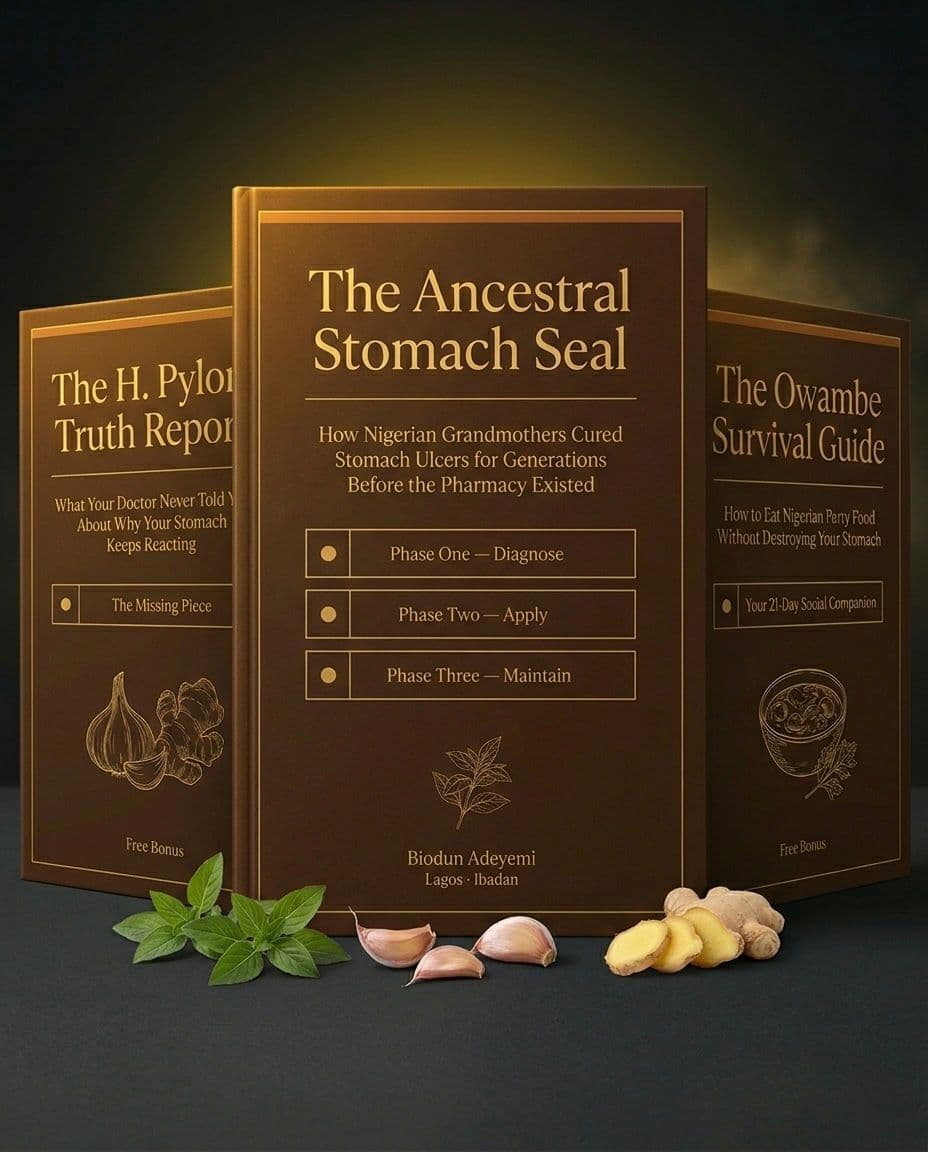
The 60-Day "Show Me It Works" Guarantee
Follow the 21-day protocol exactly as described. If you do not feel a measurable and meaningful improvement in your symptoms by Day 21 — email us within 60 days of your purchase date and we will return every naira in full. Same day. No questions. No forms. No arguments.
We are not making this offer because we expect you to need it. We are making it because we understand that you have tried things before that did not work. You have spent money before that produced nothing. We know what it costs — financially and emotionally — to invest in something and watch it fail. We are not asking you to carry that risk again. We are carrying it ourselves. You risk nothing except 21 days of your time.
That is how confident we are in this protocol — and in the experiences of the people whose words you read above.
Right Now, You Have Two Options.
Just to be completely clear: this comes with a 60-day, no-questions-asked, full money-back guarantee. You follow the protocol for 21 days. If it does not work — if your symptoms have not reduced significantly — you email us and every naira and every penny comes back to you the same day. You are not risking your money. You are risking 21 days of your time. And you are risking the belief that things can be different. We think that risk is worth it.
The price you see on this page — ₦9,800 — is available to the first 50 buyers only. After 50 copies, the price moves permanently to ₦19,500 and it will not come back down. There is no fake timer. There is no manufactured urgency. When the 50 copies are sold, the price changes — that is the only mechanism. If you are reading this while the launch price is still active, you are saving ₦9,700 simply by acting now instead of later.
I spent four years and over ₦340,000 searching for an approach that actually addressed the root cause — because I kept waiting for something that had already worked for a million people before I would try it. I understand that caution. I had it too. But every year I waited was another year of the same cycle. Another naming ceremony where I planned my plate. Another client dinner where I calculated instead of ate. Another morning with a capsule. If any part of this has felt familiar — the cycling, the hiding, the Googling in incognito mode — then you already know how you feel about this. The question is not whether you want things to be different. The question is when you decide to begin.