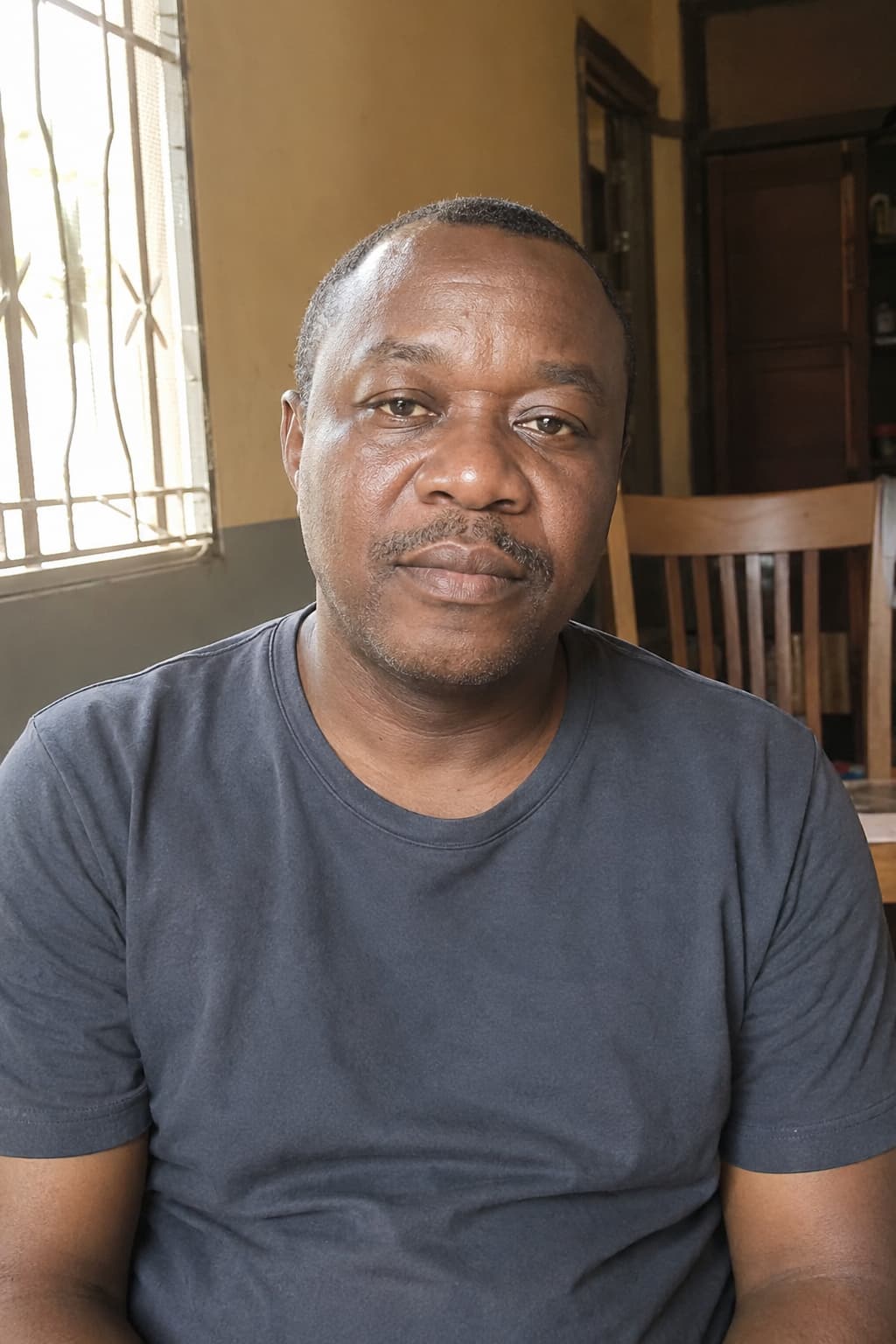
You wake up every morning and the first thing you reach for is not your phone. It is not your wife. It is the glucose meter on your bedside table.
You press the little button. You wait three seconds.
And every morning — every single morning — part of you prays that the number will be different this time.
Sometimes it is. But then it climbs back up two days later. And you cannot explain why. You ate the same thing. You took your medication at the same time. You did everything right.
So why is my body still doing this?
You have been on metformin for years. The dose has been increased twice. Maybe three times. Your doctor tells you the same thing every visit: "Continue managing it. Watch your diet. Come back in three months."
Manage it. But manage it until when?
You have tried the low-carb diet. You lasted four months. Then your sister's birthday came. Or a naming ceremony. Or an end-of-year dinner. And you looked at the pounded yam and the egusi and the jollof rice — the food your whole family was eating without a second thought — and you sat there counting grams in your head while everyone else laughed and served themselves freely.
Is this really going to be my life?
You have stopped going to certain gatherings. Not because you do not want to see people. But because the questions wear you out. "Ah, Tunde, why are you not eating? Is the food not nice?" And you smile and say you are fine and you feel like a liar.
Your wife has noticed. She has not said anything yet. But you can see it in the way she looks at you sometimes — when you push the food around your plate at family dinners. When you excuse yourself early from events. When she watches you check your meter in the morning and you do not say a word.
You stopped checking on weekends for a while. Because seeing a bad number on a Saturday morning could ruin your entire weekend. You told yourself you were giving yourself a break. But you knew the real reason.
The numbers had power over you. And you were terrified of them.
You have paid for everything. The metformin. The test strips. The private endocrinologist. The supplements from the pharmacy. The bitter leaf tea from the Instagram page that delivered nothing after three weeks of faithful use. The glucose tracker app on your phone that showed you the patterns but gave you no answers about what to actually do differently.
You have not failed. Let me say that clearly. You have not failed. You have simply been given the wrong tools for your body. A tool designed for a different food culture. A different lifestyle. A different kind of human being.
What I am about to share with you changed everything for me.
Drop everything you are doing now and listen to every word I am about to say.
This method has been around for decades. Quietly passed down in the homes of Yoruba elders who never opened a metformin pack in their lives. Our grandmothers swore by it. Our grandfathers lived by it. And somewhere along the line — somewhere between the hospital cards and the prescription pads — it got quietly buried under pharmaceutical management.
It was not lost. It was just not shared in the right format. Until now.
My name is Tunde. And the first thing you should know about me is that I am NOT a doctor. I am not a nutritionist. I am not a wellness coach. I am just a 49-year-old civil engineer from Ibadan, now living and working in Lagos, who spent over three years fighting a glucose meter that refused to cooperate — until an old man under a mango tree in Oyo told me something that changed my mornings forever.
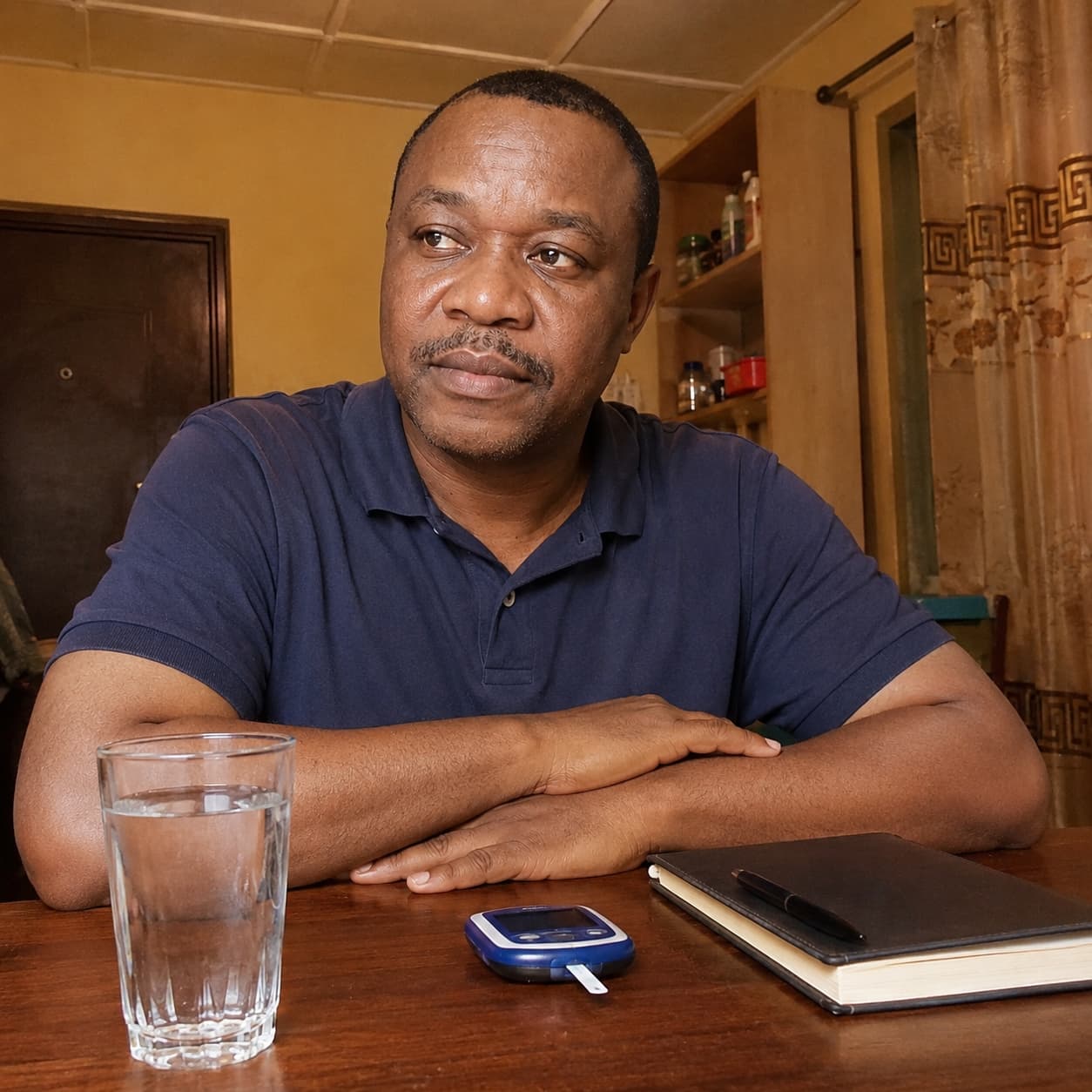
How I Ended Up in That Doctor's Office with a Reading of 11.4
It was a routine company medical check. The kind where you queue up, give blood, give urine, and expect to walk out with a clean bill of health and go back to your day.
The nurse called me aside.
My fasting glucose had come back at 11.4 mmol/L.
I did not fully understand what that meant at the time. I just remember the doctor saying the words "Type 2 diabetes" and writing a prescription for metformin 500mg before I had even fully processed what he had said. He told me to watch my diet. He told me to exercise. He told me to come back in three months.
I walked out of that clinic and sat in my car for twenty minutes before I could drive.
I was forty-six years old. I had not felt sick. I had not had any symptoms I could point to. I just felt… tired sometimes. But who in Lagos does not feel tired? I thought it was work. I thought it was traffic. I thought it was life.
I did not tell Folake that evening. I told myself I would wait until I understood it better. That waiting turned into three days. Three days of Googling at midnight in the bathroom so she would not see the screen. Three days of reading things that terrified me. Neuropathy. Kidney disease. Blindness. Amputation. My mind went to the darkest corners of the internet and I let it stay there.
When I finally told Folake, she held my hand and said: "We will handle this together." She meant it. She started cooking differently immediately. Less eba. Less rice. More vegetables. She bought a glucose meter from the pharmacy and wrote a tracking chart in a little notebook. She was more disciplined about my condition than I was in those first months.
By 2022 — nearly two years later — my dose had been increased to metformin 1000mg twice daily. The readings were still irregular. Some mornings were good. Some mornings were frightening. There was no pattern I could predict or control. And the worst part was not the numbers. The worst part was not knowing why.
The Moment I Started Disappearing from My Own Life
My company's end-of-year dinner was in December 2022. I had been to the same dinner for eleven years. I always looked forward to it — the food was excellent, the conversation was good, and for one evening the entire office became human again outside of deadlines and reports.
I did not go that year.
I told my manager I had a family obligation. I sat at home that Friday evening while Folake watched a programme in the living room, and I pretended to read a report I had already finished two days before. I did not want to explain to my colleagues why I was eating a different plate of food. I did not want the questions. I did not want the sympathy. I did not want to be the one with the health condition at a table full of people eating freely.
I started skipping my glucose checks on weekends. I told myself I was giving myself a break from the anxiety. But what I was actually doing was hiding. From the numbers. From myself.
Folake noticed I had become quieter. Short-tempered in small moments. She would ask me something simple — "Do you want me to bring you water?" — and sometimes I would snap at her before I even realised it. She never argued back. She just went quiet. And that silence was worse than any argument.
I knew she knew something was wrong. But I could not say it out loud. Saying it out loud felt like admitting that the diabetes had won. That I had become someone who could no longer control even his own body.
One evening I overheard her on the phone with her sister. She was not crying. She was speaking very quietly. She said: "I don't know what to do for him. He is not himself anymore."
I stood in the corridor outside the kitchen for a long time after that. I did not go in.
That was the night I decided I could not keep going the way I was going.
Everything I Tried That Didn't Work
I want to tell you exactly what I tried, because you may have tried some of these same things. And I do not want you to feel like you wasted money or time. I want you to understand why none of them worked — so you know what the real problem was.
Metformin from 500mg to 1000mg twice daily. Three years of faithful dose increases. My readings would improve for four to six weeks after each dose adjustment, then drift back upward. The medication was managing the symptoms. It was not addressing what was driving the sugar up in the first place.
A strict low-carbohydrate diet for four months. I removed eba. I removed amala. I removed rice. My readings improved slightly — maybe 0.8 to 1.0 mmol/L on average. But the diet was completely unsustainable in a Nigerian household. The moment I attended any gathering — a naming ceremony, a birthday, an owambe — I broke the diet. And when I broke it, I felt guilty for days. The guilt was almost worse than the glucose numbers.
Nigerian diabetic supplements from a Lagos pharmacy. Six weeks. No measurable change in my fasting readings. The packaging was convincing. The results were not.
Bitter leaf tea from an Instagram vendor. I tried this for three weeks. No quantities given. No preparation method explained. Just "steep in hot water and drink." My readings showed no consistent change. I abandoned it.
Glucose Buddy app — two months of detailed food tracking. This was actually useful in one way: it showed me the pattern. I could see which meals caused the biggest spikes. But the app gave me no protocol for what to do differently. It was a map without directions.
Private endocrinologist at ₦40,000. She confirmed Type 2. She reviewed my medication. She advised dietary changes. She was thorough and professional. But she had no guidance specific to Nigerian food. "Reduce carbohydrates" is not useful advice when your wife cooks amala and your mother serves pounded yam at every family visit and your culture lives in its food.
The Old Man Under the Mango Tree
My uncle's chieftaincy installation was in February 2024. It was held in Oyo town — a full Yoruba celebration. Pounded yam. Amala. Gbegiri. Ewedu. Assorted meat. The kind of spread that makes the whole room smell of home.
I sat at the table and ate almost nothing. I pushed the food around my plate. I drank water. I smiled when people spoke to me. I tried to look like a man who had simply eaten elsewhere.
At the elder's table across the courtyard, there was an old man I did not recognise. He was perhaps seventy-something. Sitting very still. Watching everything without appearing to watch anything. After the main ceremony ended and people began to disperse, a younger man came to find me.
"Baba Akinwale is asking for you."
I had no idea who Baba Akinwale was. But in Yoruba culture, when an elder summons you, you go.
He was seated under a large mango tree at the back of the compound. Chief Akinwale Adegboye. Seventy-nine years old. Retired herbalist from Oyo State. He looked at me for a moment before he spoke. Then he said something I will never forget:
"You are fighting your body with a drug that was made by people who do not know your food. Come and sit with me."
We talked for two hours under that mango tree.
What Baba Akinwale Told Me
He told me that metformin is a tool. It manages the sugar in the blood. But it does not address the reason the sugar keeps rising. And the reason — for many Nigerian adults — is not about eating too much. It is about eating in the wrong sequence. At the wrong times. With the wrong preparation of the natural plants that Yoruba food culture has always used alongside heavy carbohydrate meals.
"Your grandfather did not have a glucose meter," he said. "But your grandfather ate amala his whole life and died at eighty-three without insulin. He just did not eat it the way Lagos people eat it now."
He was not against modern medicine. He made that clear. He said: "Take your metformin. The doctor is not wrong. But the drug manages the sugar. The old food removes the reason the sugar rose in the first place."
He outlined four things. Four steps. Each one with a specific time of day, a specific preparation, a specific purpose. He wrote nothing down. He explained it to me from memory, the way someone explains a thing they have done every day for thirty years.
I listened. I asked questions. He answered them patiently.
By the time I walked back to my car that evening, I had taken four pages of notes on my phone.
I Almost Did Not Try It
I will be honest with you. I sat with those notes for four days before I did anything with them.
Part of me felt foolish. An old man under a mango tree just told me how to fix diabetes. And I have been to a private endocrinologist, taken medication for three years, tracked my food on an app, and bought supplements from a pharmacy — and I am now supposed to believe four steps from a Yoruba elder will change things?
But then I thought about Folake on the phone with her sister. "He is not himself anymore."
I thought about the end-of-year dinner I did not attend. The weekends I stopped checking my meter because the numbers ruined my mood. The plate of food I pushed around at my uncle's installation.
I had nothing to lose. The methods I trusted had not delivered. The thing I had not tried was free, used ingredients available at any Lagos market, and had been given to me by a man whose own fasting glucose — confirmed at a clinic in Ibadan — had remained between 5.1 and 6.3 mmol/L for thirty years without pharmaceutical intervention.
I started on a Monday morning.
The First Week
Days one, two, three — no change I could clearly measure. My fasting readings were where they usually were. I told myself not to expect miracles. I just followed the steps exactly as Baba Akinwale had described them. The bitter leaf preparation in the morning. The eating sequence at meals. The fasting window realignment. The scent leaf preparation before the last meal of the day.
Day four — the same.
I began to feel the familiar doubt. Here we go again. Another thing that sounded promising and delivered nothing.
Day five.
I pressed the button on my meter. I waited three seconds.
7.1 mmol/L.
I stared at the screen. I checked the strip. I checked the meter code. I pricked my finger again and tested a second time.
7.1 mmol/L.
It was the lowest fasting reading I had seen in eight months. I sat on the edge of my bed for a full minute without moving. Something is different. Something is actually different.
Day 18 — Folake Saw the Reading
By Day 12, I had recorded three consecutive fasting readings below 7.0 mmol/L. I had not done that in over a year.
By Day 18, Folake had noticed something was different without me saying a word. She told me later she had been quietly watching me check my meter every morning. Watching the expression on my face when I looked at the screen. She had learned, over three years, to read my morning face the way she reads the weather. She knew when a reading was bad. She knew when I was pretending it was fine.
On Day 18, she was in the doorway of the bedroom when I checked the meter. I looked at the screen. I checked it again. And then — without thinking — I smiled.
Folake walked across the room and looked at the meter in my hand.
6.4 mmol/L.
She looked at me. I looked at her. And she held my hand very tightly and said: "Tunde, this one is different. What are you doing?"
I told her about Baba Akinwale. About the mango tree. About the four steps. She listened without interrupting.
When I finished, she cried. Quietly. The way Folake cries — not dramatically, but from somewhere deep and real.
I cried too. I am not ashamed to say that.
What Others at That Gathering Discovered
I was not the only person Baba Akinwale spoke to that day. At my uncle's installation there were three other men at the elder's table who had been introduced to elements of his protocol over the years. I reconnected with them in the weeks after I started seeing results.
Biodun — a 54-year-old teacher from Ibadan — had been following Baba Akinwale's bitter leaf preparation and carbohydrate sequencing method for almost two years. His doctor had been so surprised by his last three HbA1c results that he reduced his metformin dosage for the first time since diagnosis.
Remi — 58 years old, retired civil servant from Oyo — told me he had tried to share the protocol with his brother who lived in Abuja. His brother followed it for six weeks and called him to say his post-meal readings after a full plate of jollof rice had dropped to levels he had not seen since before his diagnosis.
Alhaji Wahab — 61, businessman from Lagos — had been using the traditional fasting window method for fourteen months. He described his morning fasting readings as "almost boring now — the same good number, day after day." He said he had almost stopped checking daily because the readings had become so consistent.
These were not people selling anything. These were men at a Yoruba ceremony, speaking quietly about something that had worked for them. That carries a different weight than a testimonial on a sales page.
And that is when I knew I had to package this properly. Because too many people are sitting at too many family tables, pushing food around their plates, fighting a body that has simply never received the right guidance for its specific food culture.
After I shared my results with a few people privately — friends from the office, family members, people who sent me messages on WhatsApp after I posted a vague update about my health — the requests became too many to handle individually. People wanted the exact steps. The exact preparation. The exact quantities.
I could not sit down with every person who asked. So I did what Baba Akinwale could not do — I documented everything. The full ritual. The ingredient list. The preparation method. The exact timing. What to avoid. How to know it is working. Everything in one clear, simple guide that any Nigerian adult can follow from Day 1 using ingredients from any Lagos or Ibadan market.
I put everything inside one simple guide.
Introducing...
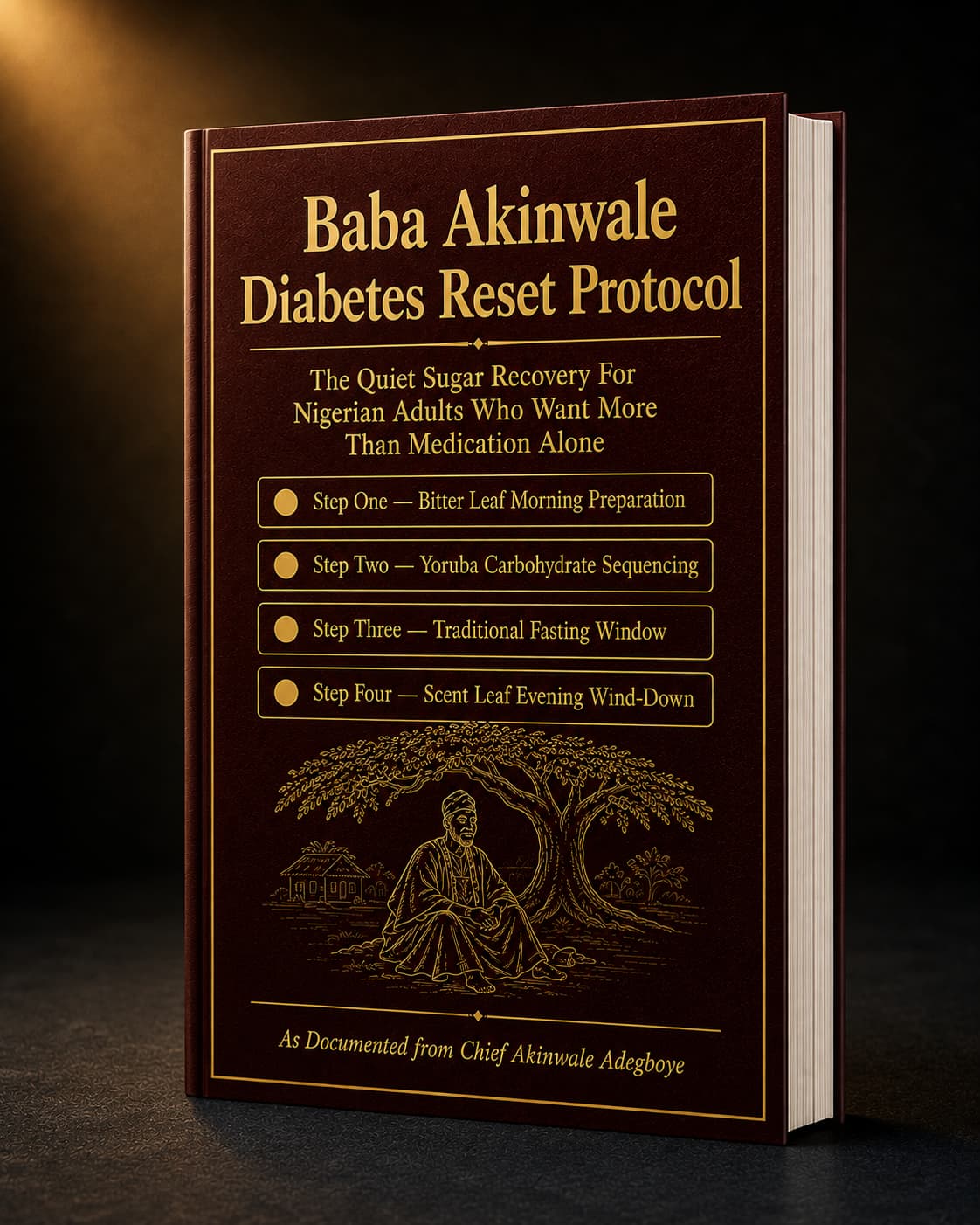
Inside This E-Guide, You'll Discover:
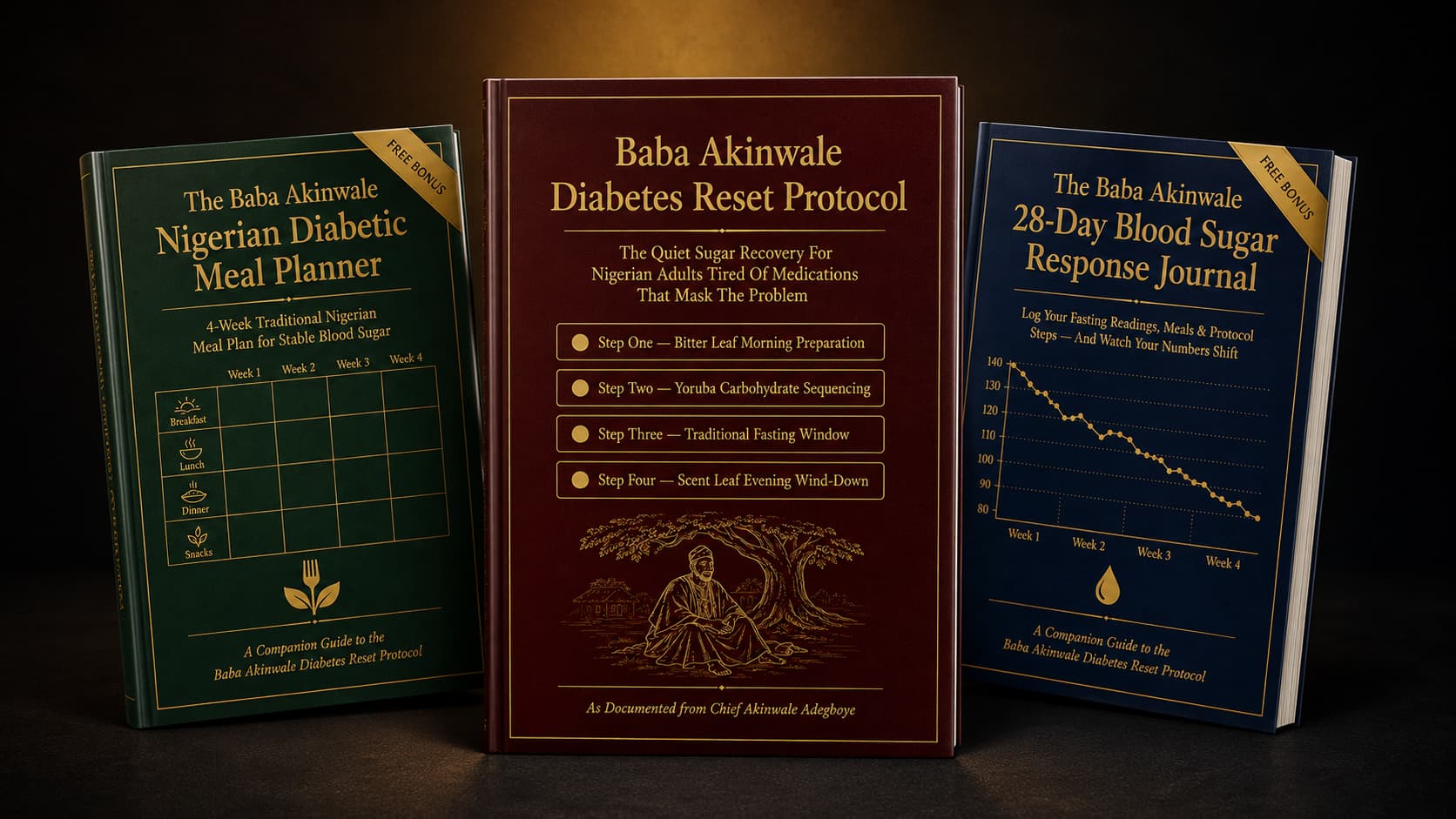
- The Baba Akinwale 4-Step Daily Glucose Reset Practice — the full protocol in exact sequence, with quantities, timing, and preparation method for each step so you can follow it from your very first morning — Pg. 3
- The Bitter Leaf Morning Preparation Guide — the precise ratio, temperature, and frequency that makes this preparation effective, and the two common mistakes that make it completely useless (most people buying bitter leaf tea online are making at least one of these) — Pg. 8
- The Yoruba Carbohydrate Sequencing Rule — how to eat amala, eba, rice, and yam in an order that slows glucose absorption dramatically without removing a single food from your diet or your life — Pg. 13
- The Traditional Fasting Window Method — how to restructure your meal timing using Yoruba daily eating rhythm, requiring no extreme fasting, no hunger, and no dramatic lifestyle change — only a quiet realignment that your body will recognise immediately — Pg. 18
- The Nigerian Glucose Trigger Map — which common Nigerian foods spike blood sugar fastest, and which traditional Nigerian foods actively support glucose regulation — a reference guide you will use every time you sit down to eat — Pg. 22
- The 28-Day Glucose Tracking Log — a daily record of fasting readings, meals, and protocol steps so you can see exactly where and when your body begins to respond — and bring real data to your next doctor's visit — Pg. 27
- The Safe Nigerian Foods Shopping List — every ingredient you need from any Lagos or Ibadan market to run the full Baba Akinwale protocol from Day 1, with no special ordering, no foreign supplements, and no expensive health stores — Pg. 31
And the best part? You do not need to remove your favourite Nigerian foods from your life, or take any new pharmaceutical drug, or follow a Western diet plan designed for someone else's kitchen. It is the same simple protocol that worked for me — and over 600 Nigerian adults have now downloaded it.
My wife forced me to buy this. I was sceptical. But by week two, she noticed I was smiling at my meter. That hadn't happened in two years. The carbohydrate sequencing section is what got me — I can now eat amala at family dinners without that spike I was always dreading. My readings after amala now are what they used to be after a plain salad. I cannot explain the science but I have the numbers.
As a woman with Type 2 going through menopause, e be like my body just turn against me completely. My endo could not give me anything specific for Nigerian food. This guide did what three years of doctor visits could not — it gave me a daily structure that works with the food I actually eat. My last three fasting readings this week were 6.1, 6.3, and 6.5. I cried the morning I saw 6.1.
I am not Yoruba so I was not sure if this would work for my own food pattern. But the Nigerian Glucose Trigger Map showed me which of my own northern dishes behave the same way — and the fasting window method applies to anyone. By Day 10 my morning reading was 7.2. That is the best number I have recorded since 2021. I already referred my brother-in-law.
Honestly the scent leaf evening preparation changed my overnight readings. I used to wake up to numbers that were higher than when I went to bed — I never understood why. After two weeks on the full protocol, my fasting readings are now consistently lower than my pre-sleep readings. Something is working differently at night. The guide explains it clearly — I just did not know this was even possible before.
Share Your Experience
Just So You Know...
Putting this guide together in a clear, usable format cost me over ₦156,000. Here is exactly what went into it:
- ✔ Traditional knowledge research and Yoruba dietary heritage documentation — ₦45,000
- ✔ Glucose response study review and protocol validation — ₦38,000
- ✔ Professional writing and editing — ₦34,000
- ✔ Design and formatting (full PDF layout) — ₦22,000
- ✔ Testing and review with a small group of Nigerian adults — ₦17,000
I am not going to charge you ₦156,000...
I won't even charge you ₦80,000...
Not even ₦40,000...
In fact, you won't even pay ₦27,500.
A fair price for me would be just ₦27,500. But today:
₦27,500 ₦9,800One-time payment. Instant download. No subscription.
✅ Over 600 Nigerian adults have already started. Join them today at ₦9,800.
Secure checkout via Nestuge — Pay by card, bank transfer, or USSD. Instant download after payment.
WAIT! I Have 5 FREE Gifts For You...
Every buyer receives these 5 bonuses alongside the guide — delivered instantly with your download.
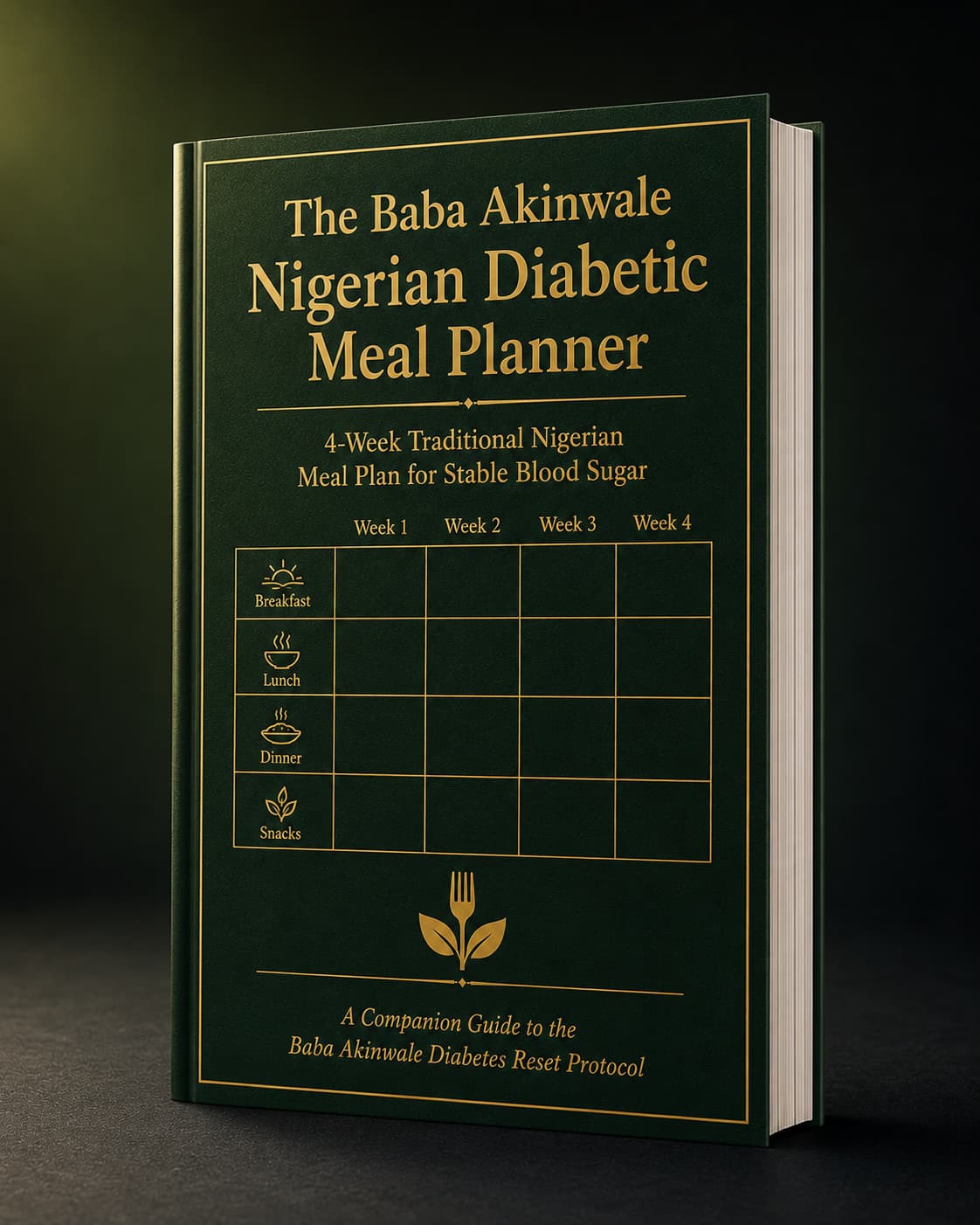
The Baba Akinwale Nigerian Diabetic Meal Planner
A 4-week meal plan built entirely around traditional Nigerian foods — with portion guidance and carbohydrate sequencing built into every meal so you never have to guess again. (PDF, instant download)
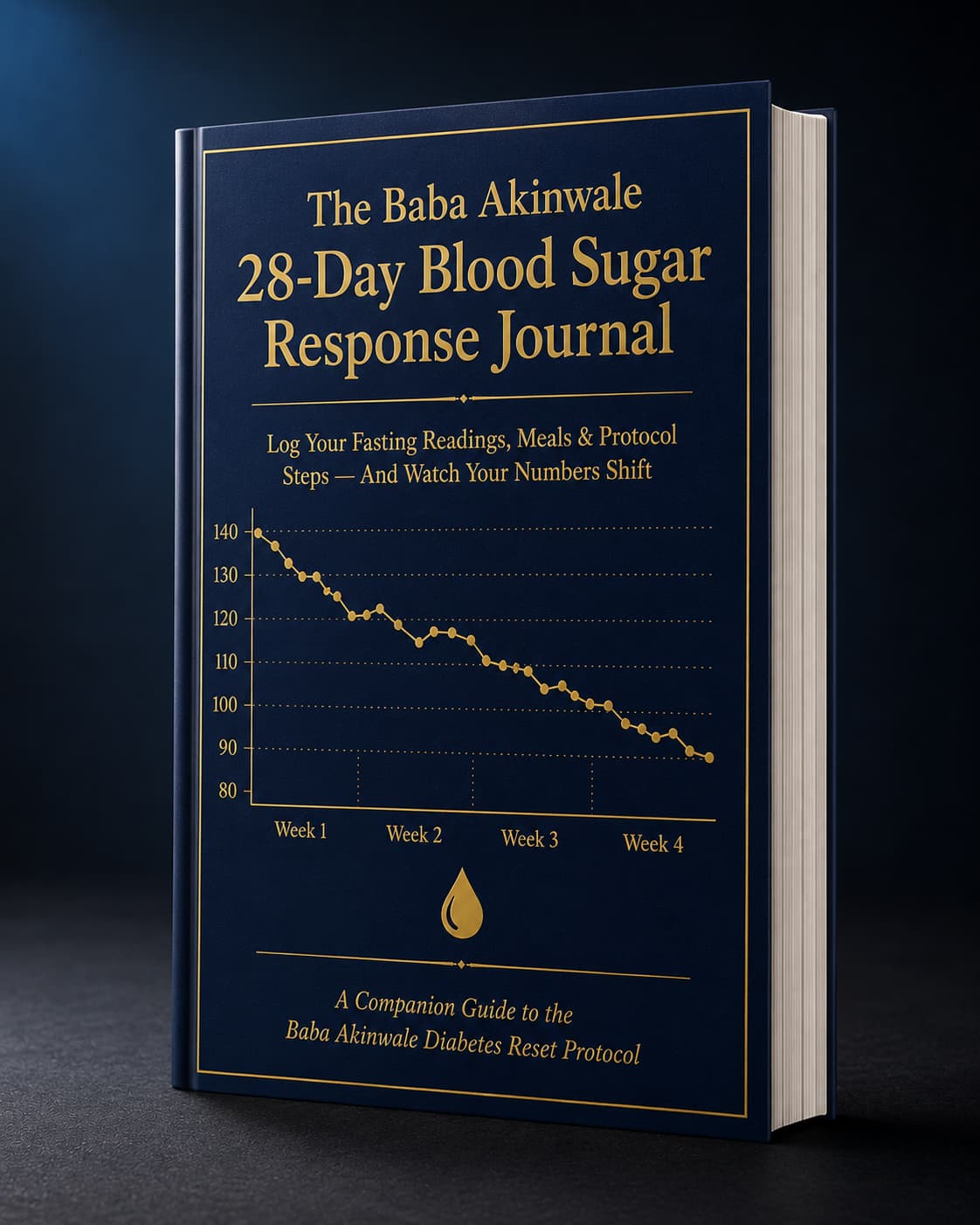
The Baba Akinwale 28-Day Blood Sugar Response Journal
A pre-filled daily tracking template where you log your morning fasting reading, meals, protocol steps, and how your body responded — so you can see your own glucose pattern shifting week by week and bring real data to your next doctor's visit. (PDF, instant download)
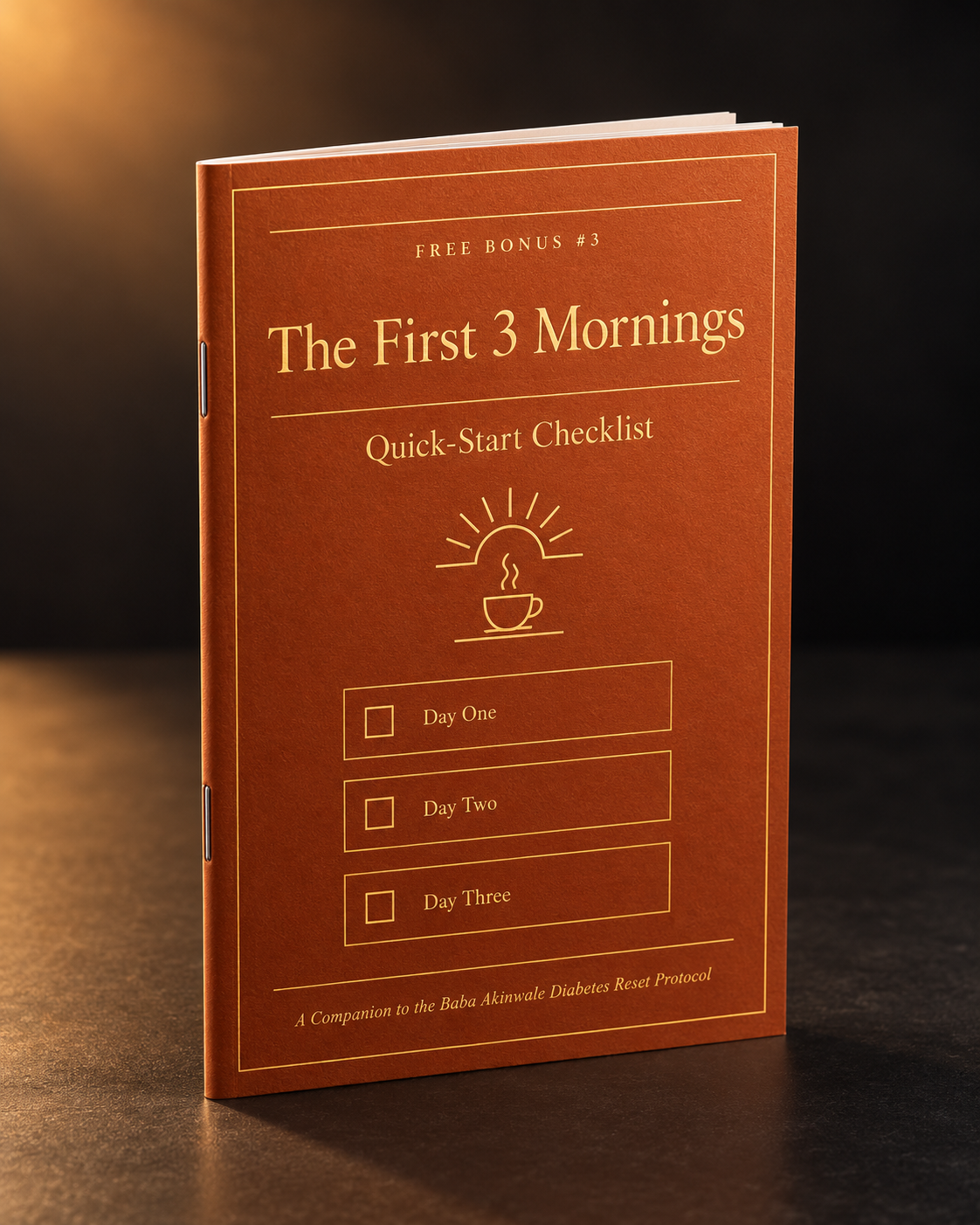
The First 3 Mornings Quick-Start Checklist
Exactly what to do on Day 1, Day 2 and Day 3 — tick by tick — so you start tomorrow morning, not someday. Includes a 2-minute medication safety check before you begin and an honest guide to what to expect in the first week. (PDF, instant download)
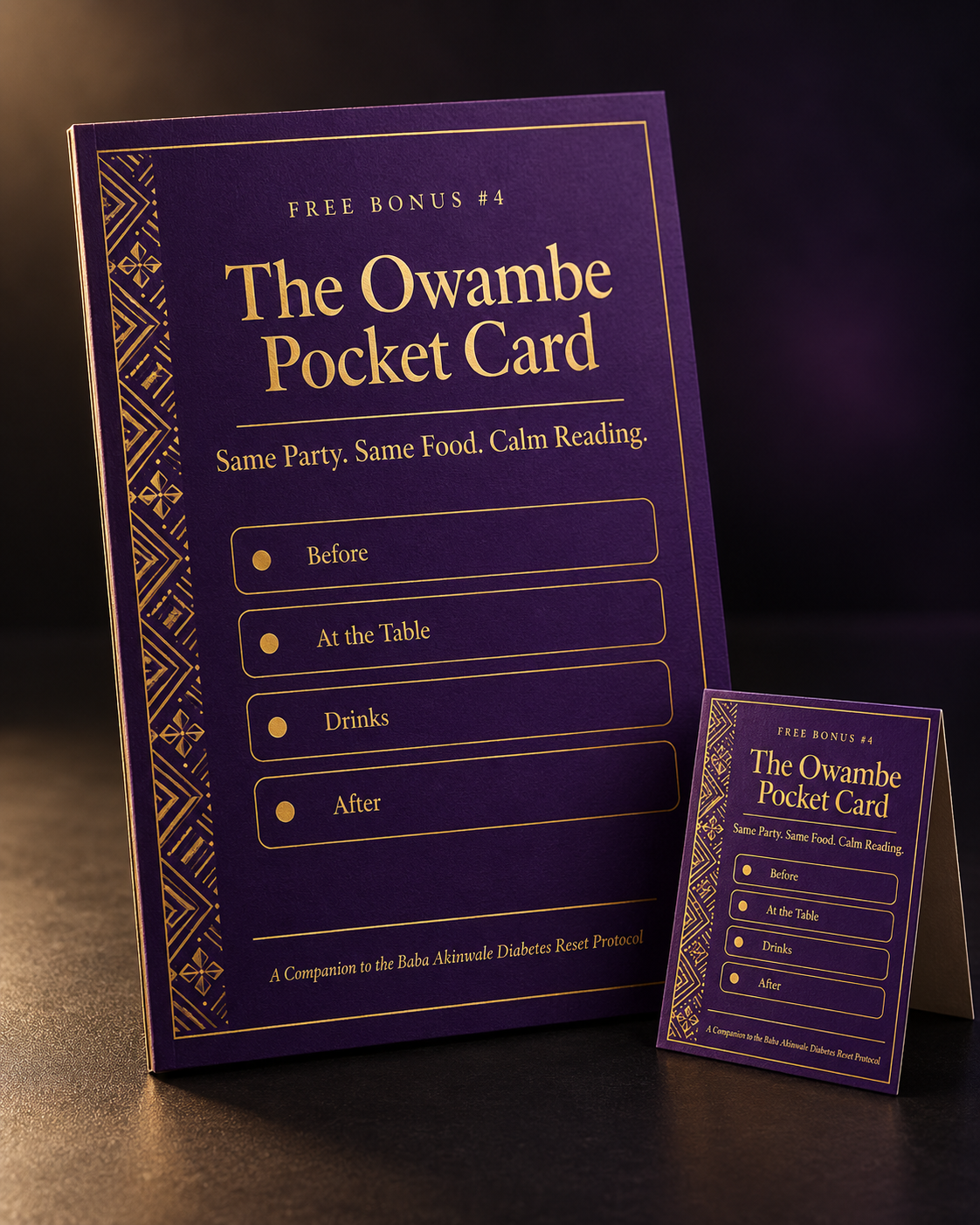
The Owambe Pocket Card
Go to every naming ceremony, wedding and owambe without breaking the protocol — and without anyone at the table knowing. What to do before you leave home, at the table, with drinks, and when you get back. Comes with a cut-out wallet card for your pocket or purse. (PDF, instant download)
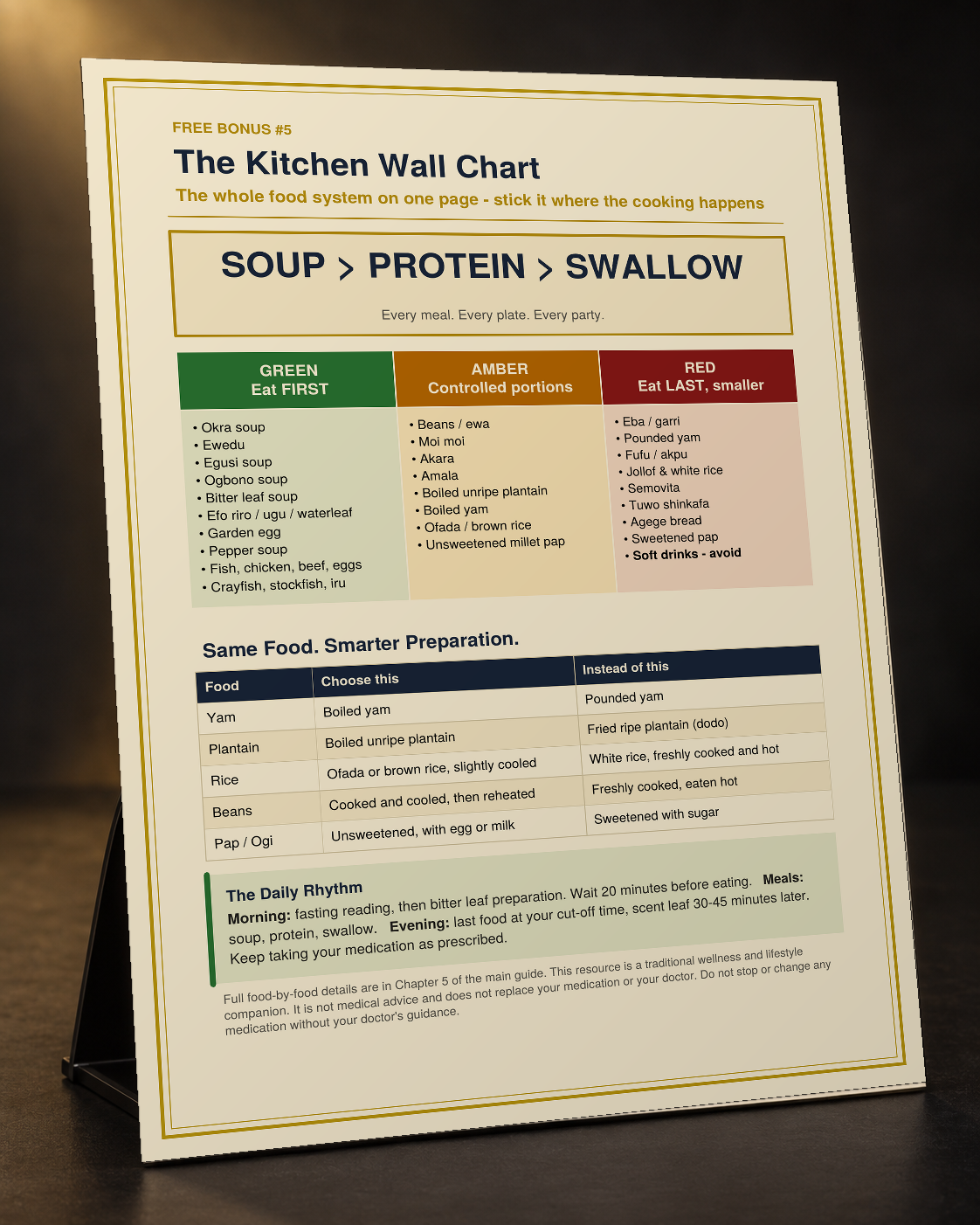
The Kitchen Wall Chart
The whole food system on one printable page — Soup > Protein > Swallow, the Green / Amber / Red food zones, and smarter ways to prepare the same foods. Stick it on the fridge where the cooking happens, so the whole household eats the right way without a lecture. (PDF, instant download)
Secure checkout via Nestuge — Pay by card, bank transfer, or USSD. Instant download after payment.
Others Are Already Taking Action...
Over 600 Nigerian adults have already gotten the protocol...
Every one of them started with the same first morning. Yours can be tomorrow.
Bear in mind — you are not the only one viewing this page right now.
₦9,800 one-time payment. Instant download of the guide and all 5 bonuses.
Still feeling unsure? I totally understand.
Which is why I am making you a bold, risk-free promise:
Follow the Baba Akinwale protocol for 30 days. If your fasting glucose readings have not shown improvement and you have followed the four steps exactly as written — send me a message. You will receive a full refund. No questions asked. No forms to fill. No delays.
I am confident enough in this protocol to carry that risk entirely myself. Because I have seen what it does for real Nigerian adults eating real Nigerian food. And I do not believe you will need that refund.
But knowing it is there removes every excuse for not starting today.
What I love about this guide is that it did not ask me to stop being Nigerian. It worked with my food. I cook for my whole family — I cannot make separate food for myself every day. The carbohydrate sequencing rule means I now eat what I cook for my family and my post-meal readings are completely different. My husband even started following it too, just to support me. His readings are also better. A whole blessing.
I was managing my glucose with only diet and prayer — no metformin, because my body reacted badly to it. My readings were up and down like a market price. This protocol gave me something consistent to do every day. Week three, my readings stabilised in a way I had not experienced before. The scent leaf evening preparation is something I will do for the rest of my life. Simple. Effective. Nigerian.
My endocrinologist gave me a target of 7.0 for my fasting glucose. I had not hit it consistently in over a year. After three weeks on this protocol — and without changing my medication — I hit 6.8, then 6.7, then 6.5. Three consecutive mornings. My next appointment is in two weeks and I am looking forward to it for the first time in years. Thank you for this guide. You cannot imagine what hope does for a person.
Before I bought this guide I told myself — one more thing that won't work. But ₦9,800 is less than one month of test strips. So I bought it. By day six I was re-reading the bitter leaf section to make sure I was doing it right because the result didn't feel possible. I was doing it right. The result was real. I have now referred five people from my church. Four of them have already messaged me about their results.
Right now, you have two choices.
Option 1: Take action. Get the Baba Akinwale Diabetes Reset Protocol. Start the four steps tomorrow morning. Give your body the structure and the traditional tools it has never been given before. Watch what happens on Day 5, Day 12, Day 18. Get your body back.
Option 2: Close this page. Keep pushing food around your plate at family gatherings. Keep increasing the metformin dose. Keep waking up afraid of a number on a small screen. Keep managing it — until when, nobody can say.
Maybe God wanted you to find this page today. Maybe He put Baba Akinwale under that mango tree for more people than just me.
₦9,800 only. Secure payment via Nestuge. Instant download. 30-day money-back guarantee.
This guide is intended to complement — not replace — your existing medical care. Always continue working with your doctor. The Baba Akinwale Diabetes Reset Protocol is a traditional wellness and lifestyle guide, not a pharmaceutical product or medical treatment.
I don suffer with this diabetes mata for almost four years. My doctor just dey increase metformin, increase metformin. I buy this guide with small hope — and I swear, by Day 7 my fasting reading was 6.8. I check am twice because I no believe. The bitter leaf preparation alone changed my mornings. Thank you, Tunde. God bless Baba Akinwale.